GPN CTF 2026 Writeup
因為考上台大了,這個暑假打算上CTFtime上找一些比賽來打。本來想說畢業當周周末來打這個GPN CTF 2026,結果開賽前突然看到零日餅乾社裡傳一個ISIP-HS CTF,比賽時間包含這個GPN CTF,結果就變成GPN CTF只解了兩三題(還簡單題XD)(都在打ISIP-HS CTF)。
Sanity Check
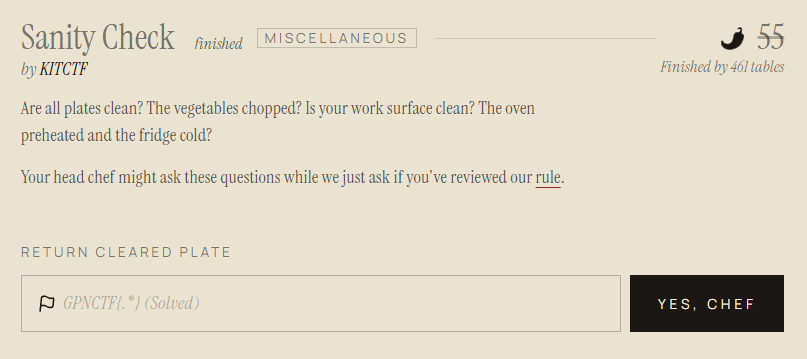
Welcome題,點進Rule看即可

Flag: GPNCTF{Yes Chef! I am ready for a fair competition}
Double Fried
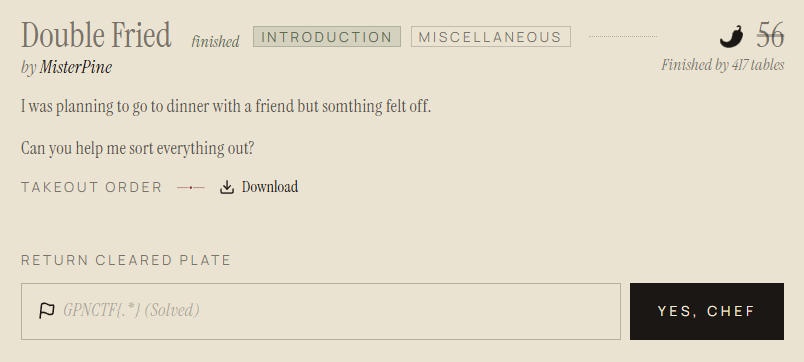
題目給了一個pcap檔案,用Wireshark去開
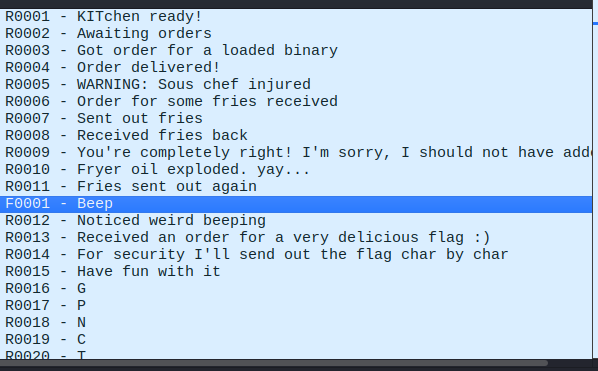
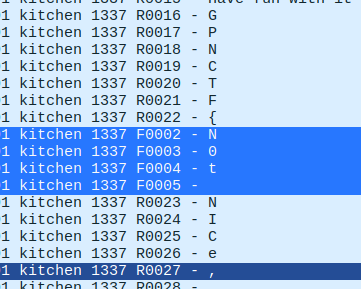
發現訊息有R開頭跟F開頭兩種,而從圖一可以猜出F開頭的是雜訊,所以我們只看R開頭的。
用frame contains "R"進行篩選
然後手動把Flag字母接起來因為我也只會人工接起來
Flag: GPNCTF{NICe, yOu FoUnD 0U7 wHO dID NOt b3L0ng ThEr3}
Auto Cooker
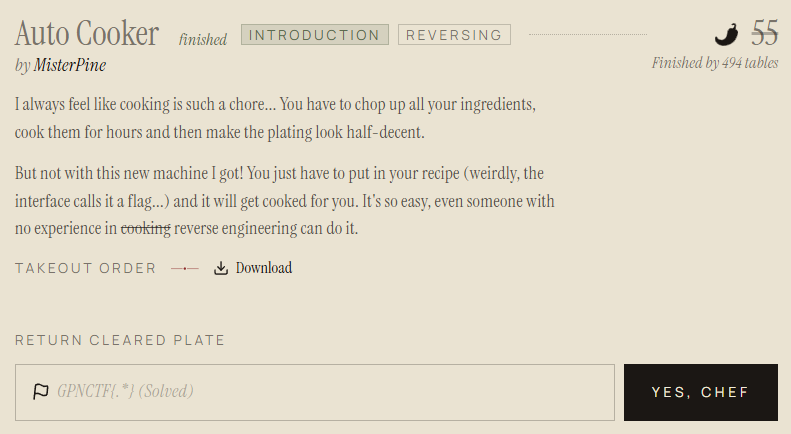
把題目給的檔案丟進IDA逆向
int __fastcall main(int argc, const char **argv, const char **envp)
{
  _BOOL4 v4; // [rsp+1Ch] [rbp-4h]

  v4 = 0;
  if ( argc > 1 )
    v4 = strcmp(argv[1], "cooking_class") == 0;
  printf("%s", HEADER[0]);
  printf("%s\n\n", WELCOME);
  puts("Enter your recipe (flag) you want to cook and confirm with [ENTER]:");
  fgets(RECIPE, 64, _bss_start);
  check_recipe_length();
  FOOD = *(_QWORD *)RECIPE;
  qword_404128 = qword_4040E8;
  qword_404130 = qword_4040F0;
  qword_404138 = qword_4040F8;
  qword_404140 = qword_404100;
  qword_404148 = qword_404108;
  qword_404150 = qword_404110;
  qword_404158 = qword_404118;
  explain_current_food(v4);
  salt();
  explain_current_food(v4);
  fry();
  explain_current_food(v4);
  trim();
  explain_current_food(v4);
  mix();
  explain_current_food(v4);
  taste();
  puts("Congratulations, you \"cooked\" a delicious plate of food!");
  return 0;
}發現它會對輸入做一連串處理,最後taste品嘗一下
看起來是他會檢查你的輸入是不是Flag,是的話就會Congratulations
首先是我們後面的函式如果要執行,都需要v4為真才行(看完下面程式碼你就動了),所以我們在執行程式時需要傳入cooking_class這個參數。也就是
./autocooker cooking_class接著一一分析每個函式
check_recipe_length
__int64 check_recipe_length()
{
  __int64 result; // rax

  if ( RECIPE[TARGET_LENGTH] || (result = (unsigned __int8)RECIPE[TARGET_LENGTH - 1], !(_BYTE)result) )
  {
    puts("Your recipe is too complicated or too simple, I already know it won't taste good :(");
    exit(1);
  }
  return result;
}
我們分析
RECIPE[TARGET_LENGTH] || (result = (unsigned __int8)RECIPE[TARGET_LENGTH - 1], !(_BYTE)result)這個判斷式的意思。
前半段檢查是否RECIPE[TARGET_LENGTH] != 0。由於C的字串結尾會填入\0
後半段用了,運算符,代表先執行前面的result = (unsigned __int8)RECIPE[TARGET_LENGTH - 1],再用!(_BYTE)result進行判斷,
即檢查是否result == 0。因此上面那串等價於:
RECIPE[TARGET_LENGTH] != '\0'
|| // OR
RECIPE[TARGET_LENGTH-1] == '\0'而RECIPE是用fget讀入,因此字串結尾會是\n\0
而我們點進去TARGET_LENGTH可以看到他的數值為3Dh,轉成10進位就是61。
因此我們需要輸入長度為60的字串(加上'\n'剛好61個字)
即Flag的長度為60
salt
__int64 salt()
{
  __int64 result; // rax
  unsigned int i; // [rsp+Ch] [rbp-4h]

  puts("Salting...");
  for ( i = 0; ; ++i )
  {
    result = i;
    if ( i > 0x3F )
      break;
    *((_BYTE *)&FOOD + (int)i) ^= GRAIN_OF_SALT;
  }
  return result;
}這串程式碼表示將字串中的每個字(包括最後的\n和\0,還有字串後面(因為雖然字串結束了,但RECIPE(或說FOOD)陣列大小為64,還沒結束)陣列初始化時的兩個\0)和GRAIN_OF_SALT XOR
點進去可發現GRAIN_OF_SALT的值為0AAh,即0xAA
fry
__int64 fry()
{
  __int64 result; // rax
  signed int i; // [rsp+Ch] [rbp-4h]

  puts("Frying...");
  for ( i = 0; ; ++i )
  {
    result = (unsigned int)i;
    if ( (unsigned int)i > 0x3F )
      break;
    *((_BYTE *)&FOOD + i) = (*((_BYTE *)&FOOD + i) >> 4) | (16 * *((_BYTE *)&FOOD + i));
  }
  return result;
}
依樣是對每個字操作,操作為以下這句:
*((_BYTE *)&FOOD + i) = (*((_BYTE *)&FOOD + i) >> 4) | (16 * *((_BYTE *)&FOOD + i));我們先令unsigned char x = *((_BYTE *)&FOOD + i);,則上面那段程式碼變為:
x = ( x >> 4 ) | ( 16 * x )x >> 4會取出x的高4位
16 * x相當於x << 4,又一個char只有8bits,因此多出來的4bits會直接被捨棄
比如若x = 0x10111001
x >> 4 為 0x00001011
16 * x 為 0x10010000
因此這個函式的功能是交換每個字的高4bits和低4bits,如0xED變成0xDE。
trim
__int64 trim()
{
  __int64 result; // rax
  unsigned int i; // [rsp+Ch] [rbp-4h]

  puts("Oops, it burned :(\nCutting off the burnt bits...");
  for ( i = TARGET_LENGTH; ; ++i )
  {
    result = i;
    if ( i > 0x3F )
      break;
    *((_BYTE *)&FOOD + (int)i) &= 0xFu;
  }
  return result;
}for迴圈從i = TARGET_LENGTH,即0x3D開始,
而和0xFu (u代表unsigned int) AND 表示刪除高4bits。
因此此函式功能為:刪掉末三個數的高位
因此
0xAA 0xAA 0xAA --> 0x0A 0x0A 0x0A
mix
__int64 mix()
{
  __int64 result; // rax
  _QWORD v1[9]; // [rsp+0h] [rbp-50h]
  unsigned int i; // [rsp+4Ch] [rbp-4h]

  puts("Mixing...");
  v1[0] = FOOD;
  v1[1] = qword_404128;
  v1[2] = qword_404130;
  v1[3] = qword_404138;
  v1[4] = qword_404140;
  v1[5] = qword_404148;
  v1[6] = qword_404150;
  v1[7] = qword_404158;
  for ( i = 0; ; ++i )
  {
    result = i;
    if ( i > 0x3F )
      break;
    *((_BYTE *)&FOOD + (int)i) = *((_BYTE *)v1 + 63LL - (int)i);
  }
  return result;
}
把FOOD整串顛倒。
taste
__int64 taste()
{
  __int64 result; // rax
  unsigned int i; // [rsp+8h] [rbp-8h]
  int v2; // [rsp+Ch] [rbp-4h]

  puts("Taste testing...");
  v2 = 0;
  for ( i = 0; ; ++i )
  {
    result = i;
    if ( i > 0x3F )
      break;
    v2 |= *((_BYTE *)&FOOD + (int)i) != (unsigned __int8)DELICIOUS[i];
  }
  if ( v2 )
  {
    puts("YUCK!\nOur taste tester thinks your recipe produces bad food, we cannot serve this...");
    exit(1);
  }
  return result;
}檢查是否FOOD中每一位都跟DELICIOUS中的相同。
因此,我們只要取出DELICIOUS的值,並把四個步驟逆著推回去就好。
exploit
#!/usr/bin/python3

delicious = [
    0x0A, 0x0A, 0x0A, 0x0A, 0x7D, 0xDD, 0x5E, 0x4E,
    0x5F, 0x9D, 0xFC, 0x2C, 0x9D, 0xB9, 0xEC, 0x5F,
    0xEF, 0xF9, 0x99, 0xEE, 0x8F, 0xE9, 0x2E, 0x5F,
    0x8D, 0xFF, 0x5C, 0x5F, 0x8F, 0x5E, 0xCC, 0x5F,
    0x3D, 0xEE, 0xE9, 0xFE, 0x8F, 0x5F, 0xFE, 0x8F,
    0xE9, 0x5F, 0xFD, 0xA9, 0x3F, 0x5F, 0x99, 0x1E,
    0x3E, 0x6C, 0x5F, 0x6C, 0xFC, 0xFC, 0xCE, 0x5F,
    0x3E, 0x1D, 0xCE, 0xEF, 0x9E, 0x4E, 0xAF, 0xDE
]

delicious.reverse() # re-mix
# re-trim
for i in (61,62,63):
    delicious[i] = 0xAA
delicious[60] = 0x0A
# re-fry
for i in range(64):
    delicious[i] = (delicious[i] >> 4 | delicious[i] << 4) & 0xFF
# re-salt
for i in range(64):
    delicious[i] ^= 0xAA

print("".join( chr(h) for h in delicious))
執行後拿到
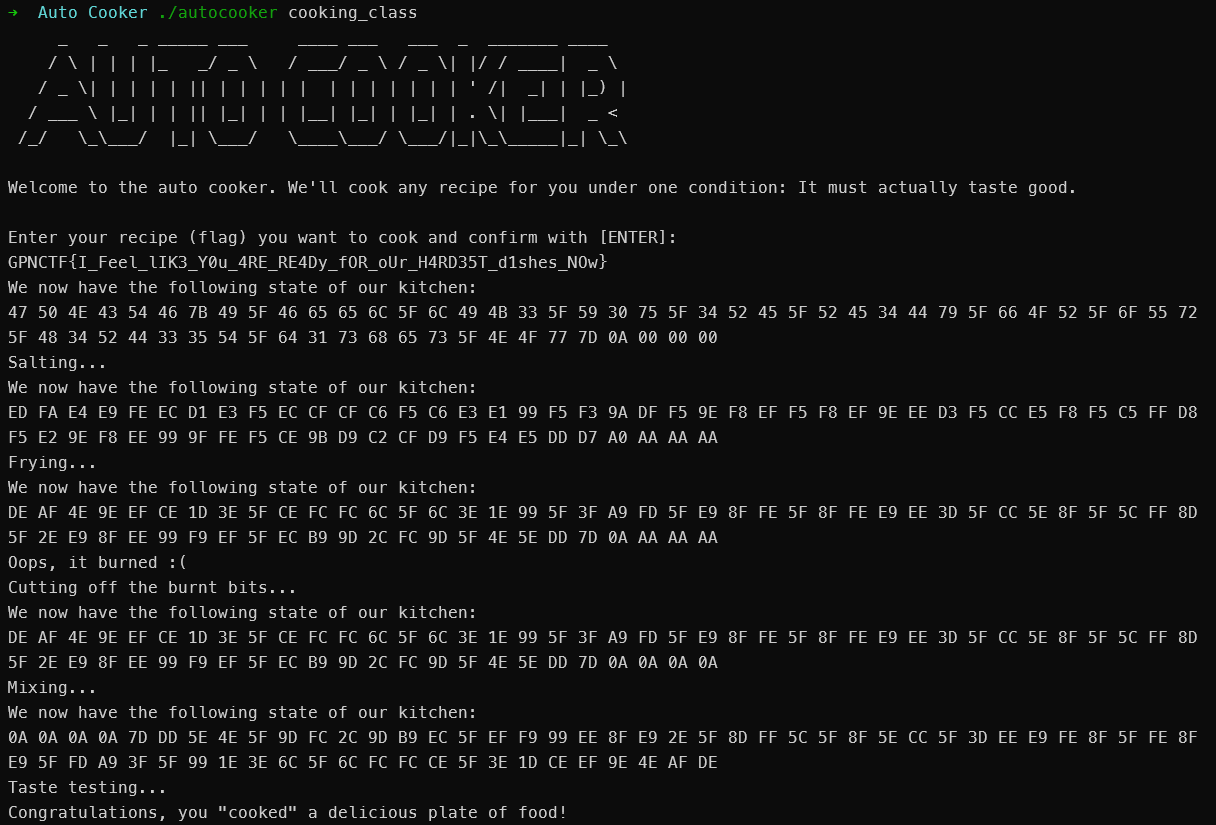
Flag: GPNCTF{I_Feel_lIK3_Y0u_4RE_RE4Dy_fOR_oUr_H4RD35T_d1shes_NOw}
以下為AutoCooker執行畫面,可以此觀察字串的變化: